

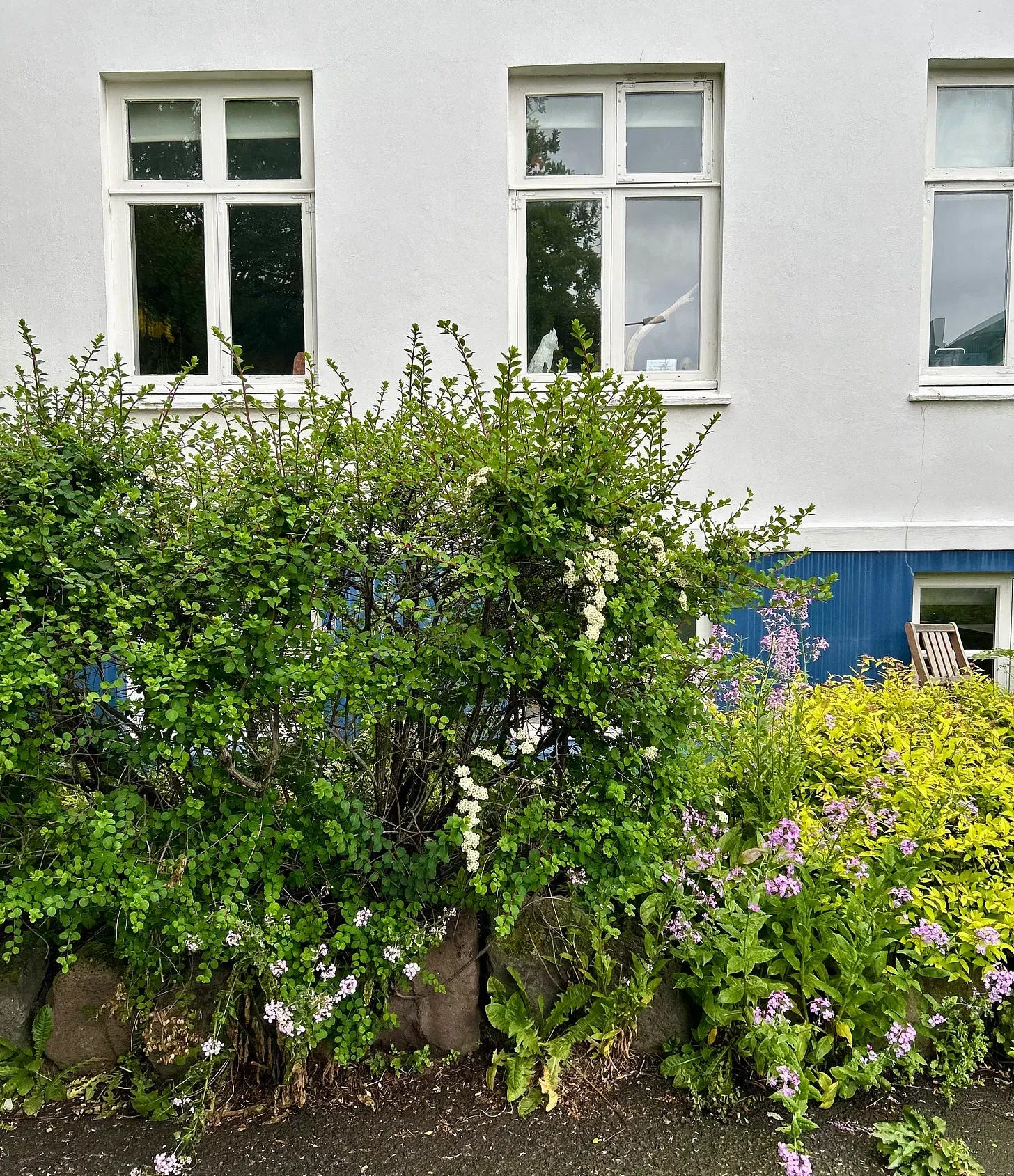
I’m in Iceland for our annual summer stay, though summer here feels like an upside-down season. The daily high is around 55 F and it’s been so windy that our whale-watching trip was canceled for rough seas. The sun hasn’t shown its face once. The sky is a glowsome dome of vague off-white that darkens somewhat overnight, like brightness turned down on a monitor. I’m generally a sun detractor, but in its prolonged absence I find myself growing nostalgic for it.
Against gray skies, gray streets, and mostly gray buildings, Reykjavík’s gardens are overflowing with green lushness. When I left, the US east coast was already browning with scorched vegetation, air fried by the sun. Here, the chilled, misty air blowing through crisp greenery is like a glass of iced cucumber water. Rejuvenating.
Let’s begin with a brief history lesson.
Reykjavík was first settled around 874 AD, when the Norse chieftain Ingólfur Arnarson established a farm there. This inaugurated the Age of Settlement, which lasted until 930 AD. The Norse settlers weren’t colonizers. They didn’t establish outposts of a mother country, and they weren’t usurping anyone else’s land — unless you count the Great Auk, a flightless seabird, and a unique species of walrus that used to call the island home. They went extinct from overhunting.
There are hints of earlier human habitation. Residual whispers of Irish hermits who sought refuge in Iceland’s quietude. There’s no direct archaeological evidence. But the Irish monk Dicuil wrote around 825 AD of certain of his brethren who lived on an island called “Thule” to the north, a place with bright summer nights just a day’s sail from frozen seas. Later, around 1122 AD, the Icelandic annalist Ari Þorgilsson composed his Íslendingabók (Book of Icelanders) and mentioned Christian monks encountered by the Norse settlers, who called them papar. These monks promptly vacated Iceland because they didn’t want to dwell among the new heathen arrivals. They left their “Irish books, bells and staffs” behind. Scholars treat Þorgilsson’s account as evidence that a historical tradition existed among medieval Icelanders, but not as proof of its veracity.
Other evidence for these hardy monks comes from Icelandic place names. Several contain variants of papar. Papey, a tiny island off Iceland’s east coast, roughly means Monk’s Island. It’s now uninhabited, serving as a popular day-tour destination thanks to its native puffins. Humans used to call it home, too; the population peaked at 16 residents in 1726, and the last permanent resident left in 1966. Despite its small size, a church still stands there, built in modern times. Is it a vestige of an earlier Irish holy building? A site’s religious character can stubbornly persist through time, with people building a series of churches on the same spot as a sort of cultural habit.
The medieval Icelandic author of Landnámabók (Book of Settlements) — possibly originally authored by Þorgilsson, but scholars are unsure — would have us think so. An extant copy tells that Ingólfur Arnarson’s clan was exploring Iceland’s southeast coast when they saw smoke rising from Papey in the springtime. They approached the island to investigate. They didn’t find papar but did discover items they had abandoned. Or so the medieval author claims, centuries later.
I choose to believe that the Irish monks made it to Iceland. I like imagining these indomitable Celts for whom hell truly was other people, and who sought their own solitary heaven on Iceland’s still-forested shores.1
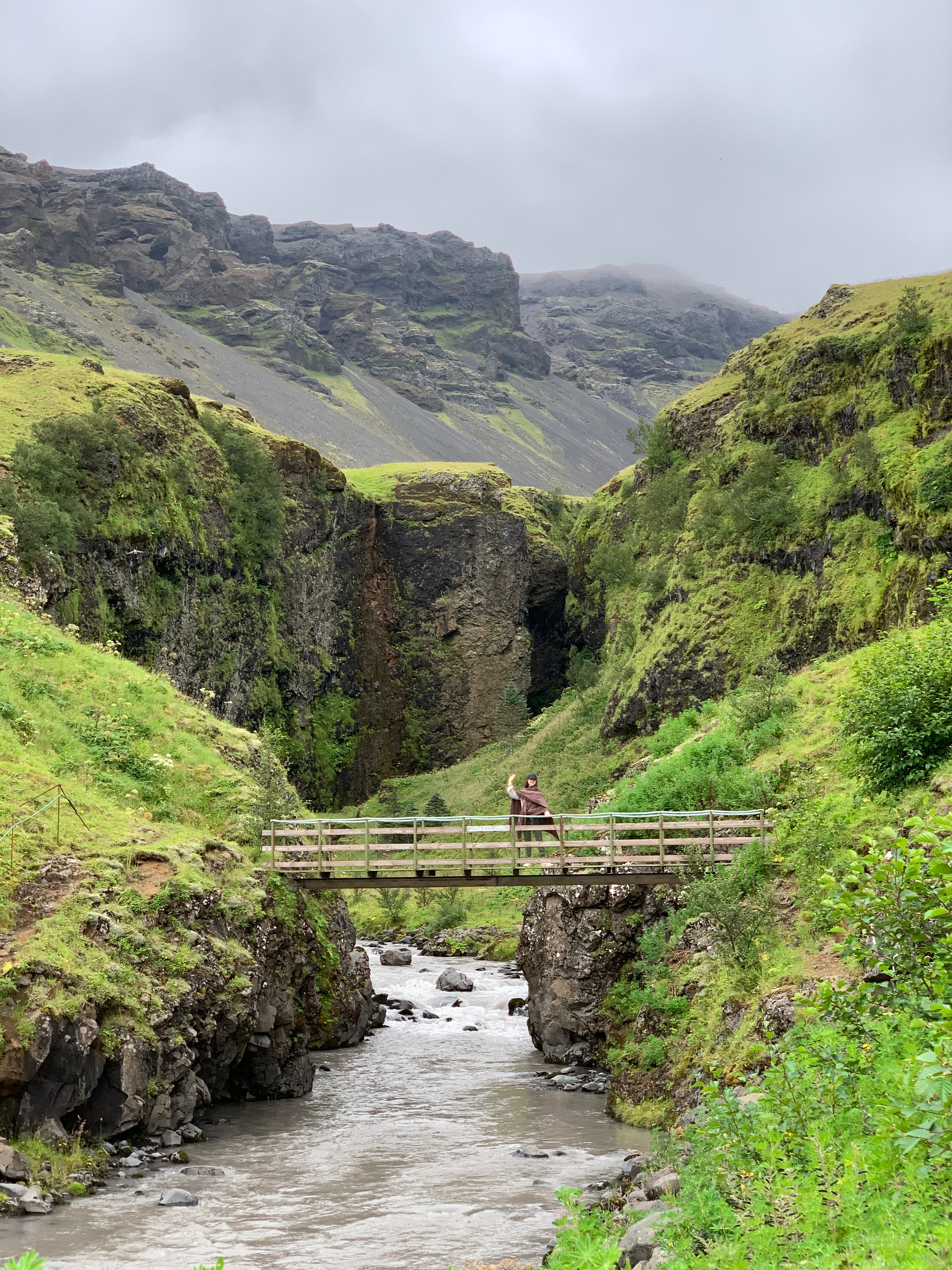
At a museum, I read that there are historians who specialize in place names. At first I’m confused. Iceland is about the size of Kentucky. How much can there be to study?
A lot, it turns out. The Place-Name Archive at the Árni Magnússon Institute for Icelandic Studies houses thousands of surveys and field reports that itemize, collectively, about 500,000 place names. The Institute’s place name archives have been digitized and are publicly accessible. I try to find records relating to Seltjarnarnes, the peninsula where my in-laws live, but instead I turn up a register of a farm in the southeast.
The farm is called Ytri-Dalbær (roughly Outer Valley Farm). The register starts by mustering its authority: Magnús Finnbogason, it is said, initially obtained the names by interviewing Páll Jónsson of Ytri-Dalbær and his son Magnús. The register was reviewed by Magnús in 1963. Appended to the original document are reviews and additions made in 1966, 1973, 1975, and 1979.
Then comes narrative recitations of places on the farmlands. West of the farmstead is Dalbæjarstapi, which means Valley Farm’s Crag — the rocky cliff takes its name from the farm. East of this crag, there’s a stream named Stapalækur, or Crag’s Brook — the stream takes its name from the cliff. Because of these linked associations, a landmark that has disappeared in modern times can still be detected from nearby place names, which preserve it in ghost-whispers.
To the farmstead’s north is Bæjarhólmur (Farm Islet), which used to be the farmstead site itself until a volcanic eruption in 1783. Nearly two hundred and fifty years later, the islet’s name still attests to this erstwhile building site.
West of the farmstead is Réttarholt (Fold Knoll) where a sheep-fold used to be. To the south there is a hillock called Hádegishóll (Noon Hillock). That name indicates that the landspeople used the hillock to tell the time — when the sun climbed atop it, it was noon. Among the property’s lava fields is a small fissure called Lambagjá (Lamb’s Fissure), where seven lambs once perished. In another direction is Marklág (Boundary Hollow), along which runs an ancient boundary-marker between Ytri-Dalbær and the neighboring farm.
In this single register for Ytri-Dalbær, 63 distinct place names are recorded for various hills, slopes, chasms, crags, streams, shorelines, lava fields, boundary markers, and old building sites.
These records are obviously valuable to historians (and papi hunters, which I feel myself becoming). But they’re also useful to geologists and scientists. In my search for registers relating to papar I find one for a region called Staðarfjall. It contains place names relating to a glacier that once existed but melted, causing a great flood that damaged the land. “When the glaciers began to melt,” the register records, “this glacier vanished, and no flood has come from it since.” Icelandic place names have shaped international geology. Geysir is the name of a specific hot spring in Haukadalur in southwestern Iceland; it means, roughly, the Gusher. The world took this single spring’s proper name and turned it into a generic term: gushing springs are called geysers from Yellowstone National Park to New Zealand. There are even “geysers” on Enceladus, Saturn’s sixth-largest moon.
Let’s not overlook the riches afforded to folklorists. In this same Staðarfjall register there is Rannveigarhellir (Rannveig’s Cave), which in one account takes its name from a troll-woman who lived there. Not far from the troll’s cave are Kolatorfur (Charcoal Grass Tongues), where:
People went to make charcoal, last in the first farming years of Þórður, Steinþór’s father. Once the brothers Þórarinn and Þórður Steinsson were at charcoal-making. Þórarinn then gets such a terrible backache that Þórður thought his life despaired of. This went on for some time. Then a swift messenger comes to Þórarinn and announces to him that his wife is about to go into labor. Þórarinn then springs up, seems entirely well, and legs it home. It was believed that he had there taken on his wife’s labor-pains along with her.
This was a hospitable land for trolls; in another area there was a troll-women colony that lent its name to Klukkugil (Klukka’s Gully, after the troll leader). Five troll-women once chased a farmer who was walking nearby. He ran for his life until he reached his living room, where he passed out. “Right up to this time it has not been thought all-clean in Klukkugil,” the register relates, “and fear has been in many when they passed by the gully.”
I found this register while looking for papar traces but there’s only a single reference within. The register’s location name, Staðarfjall, actually references a mountain (fjall). And the name of that mountain is contested. It belongs to the farmlands of Breiðabólstaður (Broad Farm), and officially, the mountain’s name is Breiðabólstaðarfjall (Broad Farm’s Mountain). But the register records that one Þórbergur Þórðarson, along with the scholar Einar Ól. Sveinsson, claim that the mountain’s name is really Papýlisfjall (Mountain of the Monks’ Dwelling). One mountain, three names. To my great disappointment, the possible origins of the name Papýlisfjall are not elaborated.
Þórbergur Þórðarson, he of the Papýlisfjall camp, is famous in his own right. Born in 1888, he was an “ironist, satirist, volatile critic, and ground-breaking achiever in experimental auto-fiction.” So says Wikipedia.
In 1934, Þórbergur wrote essays for the labour party paper Alþýðublaðið, titled “The Nazis’ Lust for Cruelty.” Upon pressure from the German consul, Iceland’s public prosecutor charged Þórbergur over passages judged offensive — among them his description of Adolf Hitler as “a sadist” and his reference to “suffering and torture that even the Inquisition itself would be horrified by.” The Supreme Court of Iceland sided with the prosecution, convicting him of “derogating a foreign nation” and fining him 200 krónur — a token amount. (This reminds me of Tove Jansson, who, as I’ve written, narrowly dodged prosecution in Finland for her satirical cartoons of Hitler.) After the ruling, Alþýðublaðið couched it as a victory of sorts, quipping that “the Supreme Court has valued Hitler’s reputation at 200 krónur.”


Þórbergur, an autodidact, wrote 47 books, and it seems only one has been fully translated into English (The Stones Speak); other translations are fragments and long out of print.
I’ve resisted learning Icelandic because it always seemed an overwhelming effort for a small payoff, namely, the ability to converse in a single Kentucky-sized country in the North Atlantic, where almost everyone speaks English anyway. But last night at dinner I told my husband that I’m flirting with the idea, not so I can spend my days here in conversation, but so I can read books and historical archives. He pumped his fist in excitement. He’ll take the win, whatever the reason.
Þórbergur Þórðarson grew up in Suðursveit, the rural district that is home to Staðarfjall, or alternatively Papýlisfjall, the Mountain of the Monks’ Dwelling, as the case may be. This isn’t a case of a famous intellectual barging in on a local name dispute; Þórbergur is a hometown boy who knows of what he speaks. I’d like to see what else he has to say.
I could go on in the same fashion, but your appetite for Icelandic historical reveries may be more limited than mine, so I’ll rest here for now. Though if there’s interest for more in this vein, I might make a part two.
Here’s a newsletter written during last year’s Iceland trip:

And speaking of Scandinavian writers, here are last year’s reflections on the Finnish-Swedish writer, painter, and illustrator Tove Jansson, one of my penates (my forthcoming Fall 2026 essay in The Philosopher draws on Jansson’s writings in depth):

In 1976, the explorer Timothy Severin set out from County Kerry, Ireland in a replica of a 9th-century currach, a two-masted Irish boat made of oak and ash wood and covered with leather. He traveled to the Hebrides, the Faroe Islands, and Iceland, and then to his final stop of Newfoundland, proving that these small but hardy boats could travel thousands of miles across the North Atlantic. The legend of the papar fights on.