

I find myself developing a video game about Hildegard of Bingen.
Which stands as my chief defense for the silence here of late. I haven’t been conventionally writing, but I’ve been doing lots of other kinds — mostly around this video game.
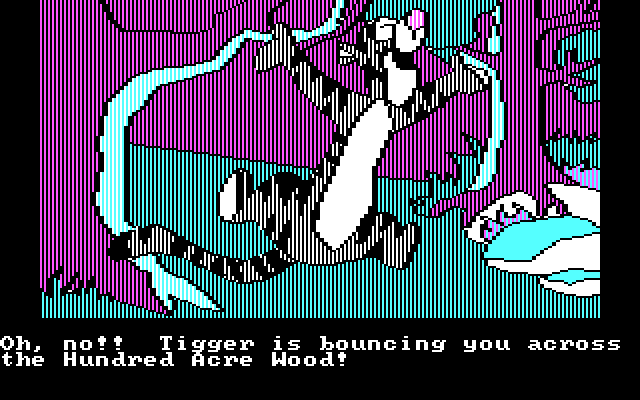
Growing up in the ‘80s and ‘90s, we always had a family computer. There was the pre-Windows PC that ran MS-DOS — a model featuring clunky white text on a black screen, and the model before that, which rendered text only in green. My earliest gaming experience was Winnie the Pooh in the Hundred Acre Wood. I was four, probably, and it gave me an early introduction to the power of immersive gaming. I’d be exploring the Hundred Acre Wood when out of nowhere, Tigger would suddenly appear, accompanied by boisterous music, to bounce me out of place — an encounter surely meant to be whimsical but striking me as startling and sinister. I’d run out of the room! And then, after calming down, I’d return to play more.
Then there was the pre-Windows Oregon Trail, rendered in black and white on our monochrome monitor. I’d name my wagon parties after 90210 characters and eagerly play on to find out who would die. (Here lies Brenda. She died of dysentery.) A measure of thrill arose from the fact that I couldn’t know who it would be. I played the game, and it also played me.
I have this tedious quality where I can’t just appreciate something but must try my own hand at it. My daughter was born wanting to know how electricity works; how trains go. That sort of curiosity is foreign to me. It’s the intangibles that I’ve sought to understand, from the inside out, by making a go myself: novels, stories, translations, plays, illustrations.
Decades of delusive self-talk — how hard can it be? — have, at long last, yielded to the working realization that I can’t simply up and do whatever the thing is, whether it’s write a screenplay, paint a portrait, found a tech startup (shudder), or design a beautiful yet climate-appropriate backyard landscaping scheme. The pattern is set: I embark, enjoy a period of feverish study and experimentation, and then at some point abandon the whole enterprise.
As for when and why I abandon a thing I’ve devoted myself to, I have two working theories. One relies on a model of “curiosity fueled by an intense phase of understanding, and disinterest once a certain level of knowledge was reached.” In other words, it’s not mastery I’m after, nor is it productivity. It’s a rush that comes during a specific phase during the pursuit of knowledge.
As for the other theory, in a meta-twist, I stumbled upon it during this current phase of video game development. In A Playful Production Process, for Game Designers (and Everyone), Richard Lemarchand quotes Ira Glass about the traps of good taste. People who do creative work, Glass says, are drawn to it “because we have good taste.” Just one problem:
For the first couple years you make stuff, it’s just not that good. It’s trying to be good, it has potential, but it’s not. But your taste, the thing that got you into the game, is still killer. And your taste is why your work disappoints you.
The essential thing, Glass says, is not to quit: eventually, your ability will catch up to your judgment. Hmm. My habit is to dive into ambitious projects while equipped with — in video game terms — exactly zero XP. I’m certain the mismatch between my taste and my ability plays a role in the project’s ultimate abandonment.
Though to my surprise, finally seeing my pattern clearly has not changed it one whit. Somehow, I can be simultaneously jaded and naive. Part of me sighs, I guess we’re doing this again, while the other part is downloading instructional books and listening to experts swap tricks on podcasts. That old chestnut about the definition of insanity feels relevant. All I can figure is that I simply like pouring energy into these things, regardless of whether they turn out.
As I got into writing this past year, I’ve often thought about the formal differences between essays, short stories, documentaries, and other things. About how the same thesis might supply the kernel for each kind of work, but would find vastly different expression given the specific form’s demands and conventions. For instance, my thesis that we overload gender with unwarranted explanatory burden could be dramatized as a short story: an idea illustrated through action and consequence, instead of stated outright.
At some point I started gaming again and added video games to my musings on form. That same idea about the misuse of gender could be redirected into the governing logic of a game — into the rules that gameplay must follow. Like short stories and fiction generally, video games involve narrative, but they also make that narrative experiential by erecting constraints and incentive structures the player interacts with. The result is that the player doesn’t just receive an idea expressed in language; they explore it as a reality.
And that’s how I find myself developing a video game.

But why one about Hildegard of Bingen, of all possible things?
There are certain historical figures I visit often in my thoughts. I’ve come to consider them as my penates, my Roman household gods. One is Hildegard of Bingen, a medieval polymath whose accomplishments made little sense against the raw facts of her life. She spent decades confined in a cell as an anchorite — anchorites were meant to be dead to the world, enclosed in a living tomb — only to emerge in her forties to found two bustling convents, advise popes and emperors, produce influential prophetic and mystical works, author treatises on nature and medicine, and compose innovative music still listened to today.1 How? Why?
I have theories. But rather than declare them to you, wouldn’t it be interesting to translate them into video game mechanics? For instance, I see a connection between Hildegard’s periods of unexplained illness and her ability to express her inner experience out loud — as though the insights and pattern-matching building pressure in her mind must be released, or else incapacitate her. As a rough parallel, imagine a game where the playable character has ideas she feels compelled to express, but the world she inhabits is violently hostile to original thought. Yet keeping the ideas bottled up presents its own kind of danger. How, then, does one express those ideas safely? And how long can one afford to wait for a safe channel? Those are some of the questions to be explored in the game.
As would the question of how Hildegard’s (and all of our) ideas arise in the first place: the mental alchemy that transmutes knowledge and sensory input into creative insight. Sleeping would figure prominently in the game, since our unconscious minds do much of the critical work of encoding, organizing, and connecting information. (Yes, not just a game about a nun, but about a nun who sleeps. Entertainment gold.) But wait: My own ideas are heavily rooted in modern science. How did medieval people conceptualize these things? Seeking answers brought me to The Book of Memory: A Study of Memory in Medieval Culture, an extraordinary work by Mary Carruthers. It’s not about memory as we think of the term; happily, it’s about how medieval people understood the entire enterprise of thinking and intellectual creation. They believed all intellectual achievement flowed from memory, which they understood as a well-ordered mental library of information. Carruthers’s book gave me exciting fuel for deepening my game concepts.
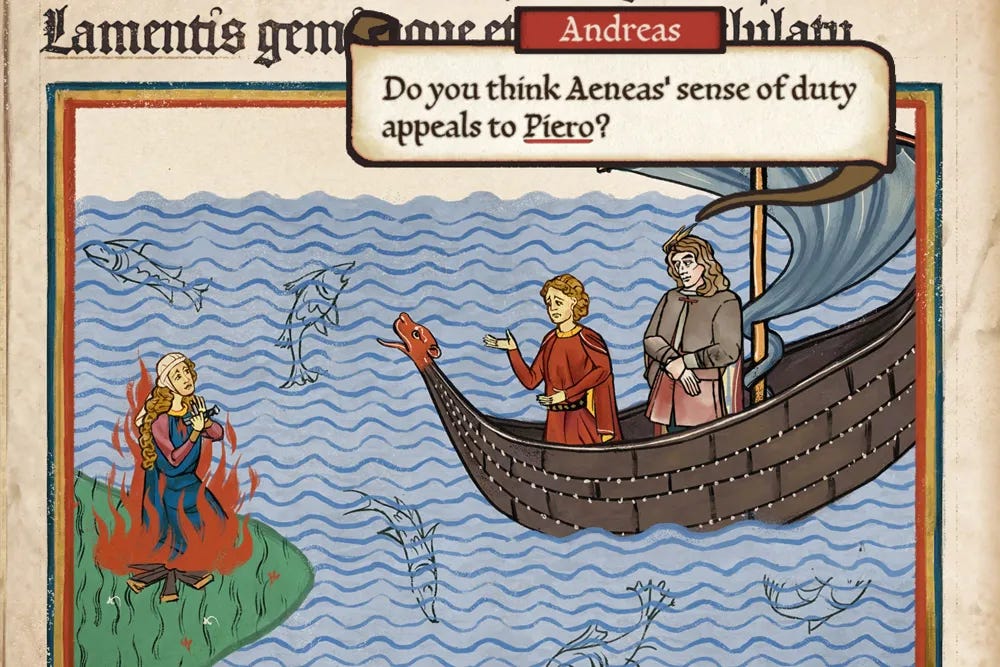
Exploring these ideas has all been great fun. But the more I read, ideate, tinker, readjust… the more I realize how outmatched I am.
As Lemarchand and other game design teachers emphasize, prototyping — creating a basic model of your idea that you can actually play — is essential. I discovered that firsthand. It was only after designing elaborate game schemes that I first turned to coding. I then made the unhappy realization that my detailed schemes rested on design premises that didn’t feel right once prototyped.
As it turns out, game development requires constant rebalancing between narrative, loops, mechanics, interface, resource ratios, graphics, and more. You can’t go too far in any one area, because you’ll surpass the needs and constraints of the others, and your work must be thrown out. In some ways, this is helpful for us restless types. Burned out from coding? Replenish yourself by drafting period-accurate letters seeking Hildegard’s counsel, or by brainstorming the precise ratios of knowledge, observation, and lore elements that produce creative breakthroughs.
On the other hand, the continual adjustments needed to keep the various elements in sync — and to achieve the overall experience you’re aiming for — is arduous stuff.
There are people who develop games solo. What I’ve set for myself is ambitious, to be sure (especially as a non-coder), but not astronomically so. To make my objective achievable, I’m planning an abstracted card tabletop interface, inspired by Alexis Kennedy’s Cultist Simulator. You won’t move through space as Hildegard, kneeling on a hard stone floor to pray. Instead, you’ll see a simple plane — representing Hildegard’s consciousness — on which 2D objects wait for you to combine them, creating outcomes represented by still more objects. Drop a book card into the read slot to get a knowledge card; drop a knowledge card into the sleep slot to seal it on the wax tablet of your mind. Choose when to speak, and when to stay silent.
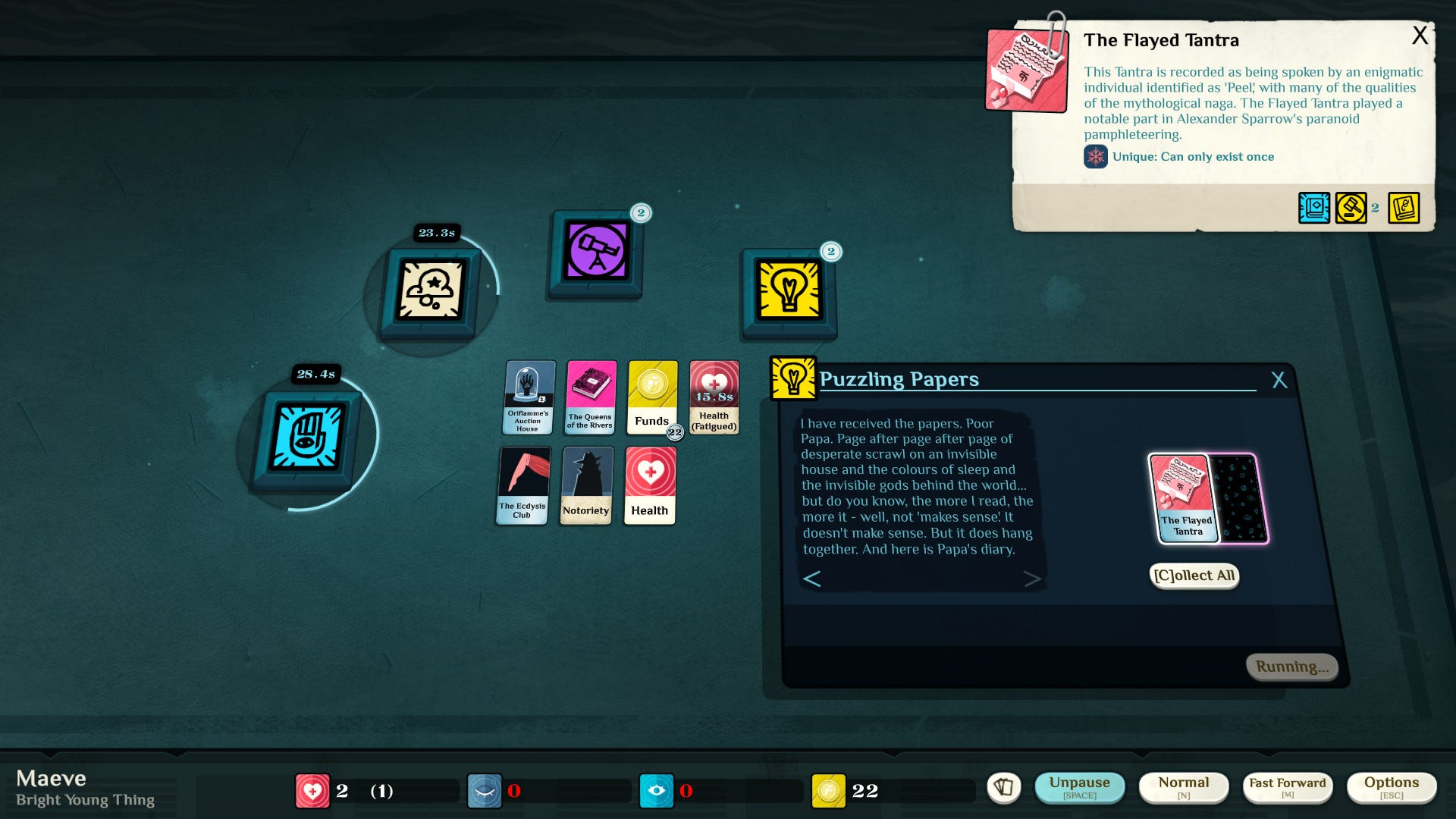
It sounds rather flat when you compare it to the breathtaking 3D worlds you can explore in big-budget games, and if it weren’t for Cultist Simulator I wouldn’t think a visually abstract approach could produce the immersion I’m after. I found an explanation for why this is possible in the course of my video game studies.
The explanation comes from another field, by way of Scott McCloud’s classic book Understanding Comics. He defined a concept so fundamentally clarifying that it has been taken up as a foundational principle of game design. Comic books depend enormously on the gutter, that blank space between boxes of illustration and text. The gutter isn’t (only) a matter of layout; it’s a space that’s alive and can be used strategically. As McCloud explains, one cell may show a villain wielding an axe, and the next, a victim. The act of violence is never depicted, and yet the reader fills in the gap – the gutter – by imagining the intervening beats. The gutter is where the work comes alive in the reader’s mind.
My tabletop interface will involve vast expanses of gutter. Content is limited and selective: succinct narrative descriptions, period-accurate smatterings of detail, cards that represent actual historical figures and works, mechanics that reflect a distinct point of view about creativity and expression. But so much is left to the interstices, for the player’s imagination to fill.
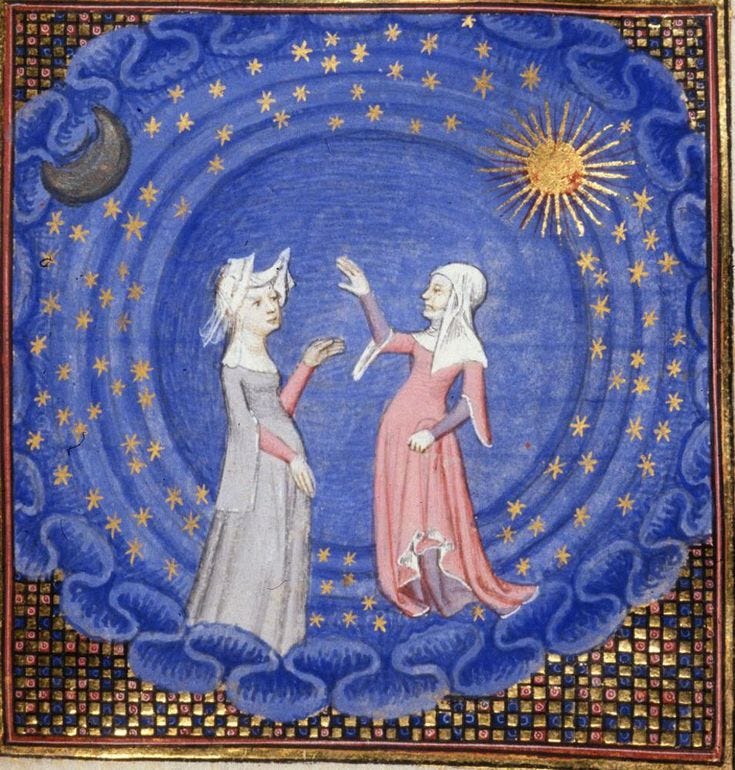
So here’s what I have in my inventory so far: a rough tabletop prototype; many typed pages of concepts and vision; a detailed character profile for Hildegard that draws on her real-life decisions and behaviors; plenty of graphical and aesthetic inspiration; and a whole lot of heedless ambition. Is it enough? I don’t know.
This particular game is being written as it’s being played. I have no idea how it ends.
As one of my penates, Hildegard naturally crops up again and again in my writing. I first described a theory I’ll explore in the game — religious vocation as a gendered life-path exemption — here:

And my theory about Hildegard’s divine inspiration kicked off this post from exactly one year ago. Strange but true: I can’t stop thinking about Hildegard of Bingen!

Thanks for reading. Stay curious.
Laura
Hildegard has 203k monthly listeners on Spotify!
I would absolutely play a game about a medieval nun, although I think I may have a medieval game bias. interested to follow along to see how it goes!
I love Hildegard, and your ideas about game mechanics sound fascinating. As a mystic myself, I studied her career for hints on how to handle spiritual experiences. I can totally relate to the health challenges that come from not expressing what's going on in my inner landscape. I've also been thinking a lot about game balance in my work as an editor for materials. It sounds like you're really on the right track here. I'm excited that you're pursuing this project!