
The Category Error, Part 2: Life before breadwinners
How industrialization rewrote men’s and women’s roles

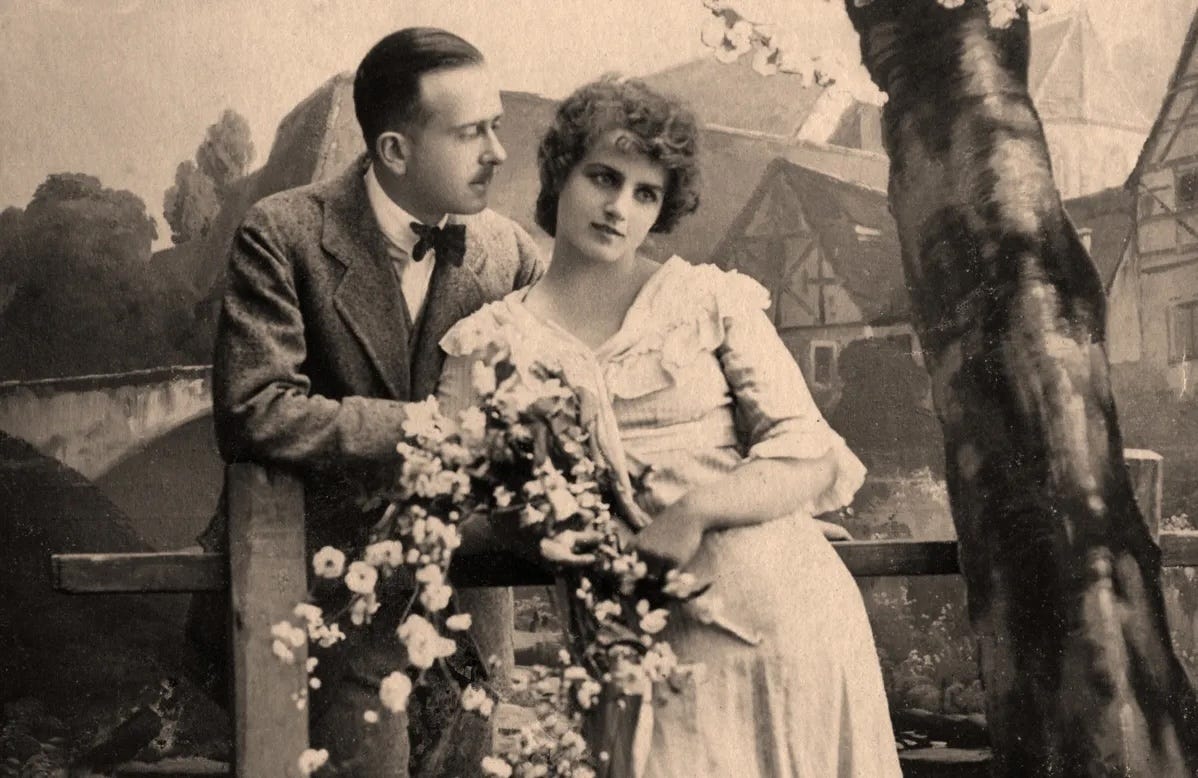
In the first essay in this series, I argued that gender functions as a kind of cognitive shortcut that sacrifices accuracy for efficiency. I showed that the qualities assigned to each sex have shifted over time—sometimes flipping entirely. The lesson was simple: what we take to be natural expressions of male and female nature often turn out to be contingent arrangements.
Yet an inevitable objection follows. Perhaps gender feels unstable today because modern life has distorted it. Maybe the system made more sense in the past—before modern institutions, before feminism, before liberal gender ideology.
This is the intuition behind some of today’s tradlife nostalgia. The story goes something like this: in more harmonious times, men worked outside the home, women stayed inside it, and together with their children they formed the basic unit that, according to a Daily Wire piece, is the “very foundation of human civilization itself.” And today’s inversion of that model, where women not only work but even helm institutions, “poses a threat to civilization” according to Helen Andrews.
This essay examines these assumptions. When we look closely at how households actually functioned before industrialization, the familiar story begins to unravel.
A brief note on scope. This essay focuses primarily on Europe, especially England, and later the United States. That is partly practical, given my own language constraint. But this focus also fits the argument. The tradlife nostalgia circulating today overwhelmingly draws on images of Western history, particularly the 19th and 20th centuries.
Before we dig in: If you like what you read, please take a second to show it! Click like, comment, restack it (with a note!)—that breaks through the algorithm and helps people find my writing.
Before industrialization: fluid families, household enterprises
The concept that a man ventures forth outside the home and a woman stays within would have been unrecognizable to preindustrial Europeans. For them, all life and work centered in the house (or haus, maison, casa, or huis), which meant not just the building but the social and economic enterprise within it. The household included its head — usually male, but could be a widow — and any spouse, children, servants, apprentices, and laborers.
In English, the word family came later in the 14th century and roughly meant the same as household. In the 1600s, when a diarist wrote about “the first that marryed out of my family” he was talking not about his son or daughter but a female servant.1
The household was the center of everything; this was true from the poorest cottager up to the king or queen. The household of Henry VIII at times expanded to 1,200 people. These weren’t just domestic servants and courtesans; they included an army of clerks, stewards, scribes, and specialists. When you were monarch, your household was the administrative state.
A family’s enterprise determined its composition. Households on large farms needed laborers; crafting households included apprentices. In the household of an eighteenth-century shopkeeper, “at least eleven different individuals […] came and went in the course of eleven years.” Each was acknowledged as a member of his “‘family,’ including his wife, child, siblings, nephews, mother-in-law, and several non-related persons.”2
Today’s concept of the commute didn’t exist. Generally, you slept in the same place you worked. In Chaucer’s Shipman’s Tale, the merchant’s counting-house — where records and cash were kept — sat above his bedroom, so that upon waking he went “up” to work.
In short, as scholar Jeremy Goldberg has written, “gender was not an especially significant factor in the organization and use of space” in medieval England.3


Children did not always live in the households of their parents. “Binding out” meant placing a child — boy or girl — into service with another household. Children as young as 7 were bound out, and they stayed with their new family until they came of age. This could be voluntary on the parents’ part or forced: under Poor Laws, local officials had the power to take children from poor households and contract them out. Apprenticeships worked similarly except they were limited to boys, and generally the boy’s family was well-resourced. The purpose was to attain valuable skills.
At the moment, I’m re-reading Hilary Mantel’s Wolf Hall. I lingered over the telling of Rafe Sadler’s apprenticeship, which began around 1515 in both fact and fiction. “Somewhere in his maze of obligations and duties,” Mantel writes, Thomas Cromwell “met Henry Sadler, and agreed to take his son into his household.”
He arranged to collect Rafe on his way back from business in his part of the country, but he picked a bad day for it: mud and drenching rain, clouds chasing in from the coast. […]
Mistress Sadler glanced fearfully outside, and down at her child: from whom she must now part, trusting him, at the age of seven, to the weather and the roads.
As Rafe reaches adolescence, Mantel depicts his relationship with his apprentice master as something between a son and an employee in a family business. And that’s exactly what these households were: family businesses. In historical fact, Rafe Sadler remained loyal to his master long after Thomas Cromwell’s political fall and execution, defending Cromwell’s legacy just as he took the Holbein portrait into protective custody, preserving it from destruction.
As we’ve seen, family composition was malleable as children, servants, apprentices, and extended kin came and went. Although gender roles existed — partly determined according to practical considerations: driving plough teams, felling timber, and shearing sheep demanded the strongest hands on offer to keep pace and avoid injury — how strictly they were kept varied.
On farms, women pitched in during labor-intensive periods, helping to ensure both figuratively and literally that the family would “make hay while the sun shines.” The work cared not for who was around to perform it, but simply that it got done.
More officially, a woman’s role was to produce; she turned raw materials into consumable goods. The late medieval Book of Husbandry (1523) described women’s responsibility for marketing butter, cheese, poultry, ale, and other produced goods, as well as taking grain to the mill. Peasant gardens were tended by women, who peddled their surplus produce in baskets carried through villages and town centers.4
But don’t mistake me; women’s work counted as physical labor, too. Brewing, harvesting grain, laundering heavy linens, tending livestock, and hauling fuel were all punishing tasks — and all of it was women’s work. By the way, brewing presents one of those stark gender flips I wrote about in my first essay. It used to be almost entirely women’s work, part of the larger pattern where men produced the raw material and women refined it into consumable goods. Now, brewing is heavily associated with male culture.5


Just as women shared in economic production, men shared in domestic work. In many households the father instructed children in reading, arithmetic, and catechism. Apprentices — almost always boys — swept floors, scrubbed pots, hauled chamber waste, rocked infants, and slept in the same crowded rooms as the family whose trade they were learning.
When a husband died, his wife often took over as head of the family business. This was particularly true of crafting households. Guilds generally excluded women but made exceptions for widows, who could inherit and operate their husbands’ shops. Women-headed households were normal in the Middle Ages, not aberrational. Again we see that gender roles were contingent rather than absolute: the kind of work you did depended on who else was around. It’s not that women were strictly excluded from commercial activity, it’s that priority went to men. Medievalist Eileen Power said in the early 20th century that women enjoyed a “rough-and-ready” equality with men, and though some scholars say this overstates it, I take “ready” to mean this: when an authority gap opened, women were eager to fill it.6
But these were not egalitarian times. Yes, women had a degree of agency and autonomy, but it was bounded by a cliff’s edge. In the 14th century women monopolized brewing because it was seen as low status; as commercial brewing developed (a precursor to industrialization), it became higher status and thus the domain of men. In 16th century Essex parish records, widows who lived alone and engaged in small-scale commercial activity were disproportionately accused of witchcraft. In Germany, women who controlled small property or earned income from midwifery and healing — practices outside male control — were especially vulnerable. As too were widows embroiled in inheritance disputes with male relatives. Conveniently, if a widow were convicted of witchcraft, she was disqualified from inheriting.
In the centuries preceding the formal beginning of industrialization, and as centralized production sprang in pockets of industry, laws were already starting to change in a way that reduced women’s property and political rights and narrowed their scope to domestic affairs.
Industrialization pushes the sexes into “separate spheres”
Then: industrialization. When production moved from disparate household enterprises to centralized factories, taking off in large scale around the 1790s, collaboration among householders gave way to individual wage competition. Jobs were finite, and employment was zero-sum. The personal cost to you of a neighbor obtaining one of those factory jobs couldn’t be ignored. Society shifted from a community mindset to a more individualistic one.
Family members no longer offset their costs by contributing to the household’s enterprise. When in-home production vanished in lieu of outside wage-earning, additional dependents became net drains on resources. So, households shrank. By 1850, the average white woman in the US had about five children, half as much as her great-grandmother.7
As the household’s centrality evaporated, the term family shifted to how we use it today: a unit of parents and their dependent children. Stripped of economic and productive significance, the family became sentimentalized. This is when the conceptually distinct spheres of public commercial activity on the one hand, and private domesticity on the other, took hold.
Industrialization did more than reorganize labor; it reorganized imagination. The industrious, commercially-active women of preindustrial times became the delicate middle-class flowers of Victorianism, too feeble in body and intellect to participate in the roughness of the market.
In The Working Life of Women in the Seventeenth Century, a seminal text from 1919 and one of the earliest academic treatises written by a woman, Alice Clark investigated the shift in women’s roles. Writing of her own “modern” day, domestic work now fell entirely on mothers, who “remain in a state of dependence and subordination — an order of things which would have greatly astonished our ancestors.”
Initially, women were not discouraged from participating in the new manufacturing economy. Early industry in the United States and England relied heavily on female labor. The first textile mill owners hired entire families to work in factories together.8 But formerly independent farmers did not adapt well as a group to factory discipline. Pivoting, mill owners targeted the unmarried daughters of New England farmers for recruitment, whose household labor was no longer as vital given technological improvements and shrinking household operations.
As competition intensified, mill owners cut wages and worsened conditions, provoking strikes. One such strike was spurred by a factory owner’s decision to cut wages by fifteen percent. A worker who tried to organize a protest was fired, which incited the very protest the owner had sought to suppress. As reported by the Boston Transcript, nearly 800 female workers
marched about the town, to the amusement of a mob of idlers and boys, and we are sorry to add, not altogether to the credit of Yankee girls.
The strike failed, as did others, such as one demanding (only) a 10-hour workday.9


Thinking of these overworked women marching for fair and equal treatment as onlookers jeered, my insides twist. How can you hope to battle political power when you can’t even vote?
For their part, mill owners defended the low wages because women did not have dependents to support. But the premise wasn’t true. Women had children, husbands, parents, and siblings who needed support. Instead, the mill owners were making a normative argument. Women shouldn’t be supporting families, and so we won’t pay them enough to do so. Because of this wage discrimination, women couldn’t support dependents — which was then used to argue that women were incapable of providing.
As women became ever more overworked and underpaid, those who could leave the workforce, did. They left in droves, providing more fuel for the “separate sphere” ideology. It’s important to remember that these women weren’t leaving jobs that were neutrally available to either gender on the basis of merit. They were leaving inhumane, low-paid jobs specifically structured for women.
But women never fully left the paid workforce, especially immigrants and unmarried mothers. Factory owners benefited from paying these women one-third to one-half of the prevailing male wage. This created a trap where women were hired on the cheap, and then socially stigmatized for working such demeaning jobs.10 Working for wages ultimately became an emblem of low status for women.
A man’s ability to keep his wife at home became a signal of his own success and contributed to his sense of self-worth. The corollary is that a working wife threatened these things.
It wasn’t just the factory owners and their well-heeled allies who closed rank against women workers. Male workers and their trade unions saw them as competition. Unions excluded women and demanded in labor negotiations that women be banned from factories. They championed the concept of a “family wage,” a wage high enough for a man to support a non-working wife and children. Despite its name, the family wage was available only to men who supported families, not women — more aptly, they were organizing for a “men’s wage.” Direct gender conflict had existed in preindustrial times, but in more episodic settings: inheritance disputes, marital laws. Now, the pitting of men against women was a pervasive condition of the new wage economy.
Reinforcing these battles playing out on factory floors, a new gender ideology defined women through the virtues of social cooperation and submission: gentleness, sensitivity, altruism, empathy, and tenderness. These purposefully contrasted with the new masculine virtues that were steeped in competition: ambition, authority, power, vigor, and calculation.
During the industrial era, in 1865, John Ruskin wrote sentimentally about man’s “rough work” in the “open world” and woman’s gentle place “within his house,” where she was protected from “the anxieties of the outer life.”


In the same vein, The Angel in the House is a 19th-century narrative poem by Coventry Patmore that fictionalizes his wife as the “ideal” woman and offers rich evidence of the new Victorian paradigm. A woman’s role was to be subservient to her husband, to soothe him and boost him so that he could better compete in the wage-earning world outside: “Man must be pleased; but him to please / Is woman’s pleasure…” The wife existed to absorb, uncomplainingly, her husband’s stress.
I look over at our dog, curled up like a donut. I’m not as regular with her walks as I should be. And when at last I take her, she doesn’t complain. Bygones are bygones; she is simply delighted about the walk ahead. The wife in The Angel in the House is expected to show a similar disposition:
While she, too gentle even to force
His penitence by kind replies,
Waits by, expecting his remorse,
With pardon in her pitying eyes.
Some object to our modern term “emotional labor,” but this is something very much like it in verse form. The wife is meant to absorb the psychological damage produced by the competitive male public sphere.
On wings of love uplifted free,
And by her gentleness made great,
I’ll teach how noble man should be
To match with such a lovely mate.
Here is classic Victorian feminine morality. The woman’s virtue elevates the man. She doesn’t act in the public sphere; she inspires the man who does. As for her life’s goal, her “wish” is “to be desired” — nothing more.
Reflecting later on how society’s expectations interfered with her writing, Virginia Woolf lectured about her own Angel in the House, an internalized version of Patmore’s:
She was intensely sympathetic. She was immensely charming. She was utterly unselfish. … She sacrificed herself daily. If there was chicken, she took the leg; if there was a draught she sat in it — in short she was so constituted that she never had a mind or a wish of her own, but preferred to sympathize always with the minds and wishes of others. … In those days — the last of Queen Victoria — every house had its Angel.11
Woolf, born in 1882, grew up when Patmore’s Angel was the culturally dominant model of femininity. Her parents were among the first generations fully formed under this Victorian public-private divide, and they followed its strictures to a T. But for Woolf, the inner Angel of her upbringing chafed: “It was she who […] so tormented me that at last I killed her.” Woolf’s generation was the first to revolt publicly against that model, even as many middle- and upper-class women continued to embrace it.
Pause for a moment to consider the order in which this all happened. It wasn’t that the identification of women with genteel domesticity came first, and because of that, only scattered and demeaning work was offered. Instead:
The shift from household production to wage-earning spurred individual competition.
Men saw women as direct economic competitors, prompting them to demand women’s labor exclusion and wage suppression — which factory owners supported.
As women’s working conditions worsened, they fled the workplace if they could, hardening the nascent “separate spheres” and making paid work a sign of low female status.
For married women who worked, that low status reflected back on husbands, who competed even more fiercely for jobs that paid enough to support non-working wives.
Competition and dog-eat-dog status contests largely made society what it was then, and what it continues to be today.
When you see how the dominoes fell, you also see that it didn’t have to be that way. None of these outcomes resulted because women are intrinsically incompetent, too delicate to work hard, or more “naturally” suited to sweeping and caring for children. Women had worked competently and vigorously for centuries — on farms, in workshops, in taverns, managing household logistics and organizing servants’ workstreams — where they balanced competing demands, thought both strategically and pragmatically, and made constant calculations on what to prioritize and how to problem-solve.
From the time industrialization took root, it only needed a short doubling back into the past, a brief retracing of steps, to reenter a time when everywhere men were found, women were too, working alongside them.
The 20th-century womanly identity: creative homemaker, moral exemplar
The shift away from women’s traditional role as economic co-producers gave rise to a new ideology, one that recast women’s shrunken domestic role as an expression of their nature. By the mid 19th century, middle-class women were cast as the “moral guardians of civilization,” even though, as revealed in my last essay, traditionally women were believed to have worse morals than men.
Pundits cited women’s “delicate sensibilities,” lack of physical stamina, and even “small brain[s]” to argue they were unfit for the public sphere.12 This reached its peak in the 1950s, when women were heavily pressured to find “complete pervading contentment” in motherhood and “creative homemaking.”13 Women who could not adjust to these domestic roles, or who sought independence or abortions, were pathologized as “unnatural,” “neurotic, perverted, or schizophrenic,” and some were even subjected to institutionalization or electric shock treatments.14
In practice, this new womanly ideal was reserved for white, native-born, middle-class women. For every middle-class woman protected within her “separate sphere,” there was an Irish or German girl scrubbing another woman’s floors, a black woman doing another family’s laundry, and Italian or Jewish daughters working in sweatshops to sew another family’s clothes. These women were not thought to be too delicate to work outside the home; apparently, class and race were higher-order categories that stamped out natural feminine delicacy. What’s inarguable is that these women’s suppressed wages and poor working conditions facilitated the higher quality of life that other families enjoyed, and that many look back on today as a lost paradise.
In the first half of the 20th century, there were periods when native-born and middle-class white women returned in large numbers to the paid workforce.
During the Depression, more married women sought employment as their husbands were laid off. And as it had during the early days of factory work, the scarcity of jobs meant that women’s labor participation was again met with concerted, institutional pushback. In the 1930s, federal laws and business policies discouraged the hiring of married women and mandated that they be first fired in cutbacks. Twenty-six states passed laws prohibiting their employment.
And then the resulting state of affairs was seen as evidence of women’s inherent inferiority. Women cannot support families, so they must be inferior. Women can only work menial and low-paying jobs, so they must be inferior. If women are so inferior, then why are laws and other structural oppositions against women’s work needed in the first place? Surely their inferiority would — on its own — ensure they received only low wages and were relegated only to menial work. Right?
But rhetoric and policy outcomes were different when jobs weren’t scarce. During World War II, women returned to the workforce in droves, and for the first time, they weren’t confined to undesirable jobs. Governments enacted policies that actually supported women in the workforce. For instance, the U.S. federal government also financed daycare centers for working mothers. At their height, these centers supported 1.5 million children. This experience of working in high-impact, desirable roles “gave thousands of women who had already been working their first experience of occupational mobility and the rewards of challenging, well-paid work.”15
But when the men came back, women were cut loose. They were laid off or reassigned to less desirable jobs, despite polls showing that the majority wanted to continue working.
Here’s what gets lost in today’s tradlife nostalgia: the day-to-day reality beneath the 1950s ideal. There was discontent.
In Blue-Collar Marriage published in 1964, most housewives polled believed that women had it harder than men in marriage, with responses including: “She is more tied down”; “She is practically in jail.”16 One-third of the housewives of blue-collar workers who participated in research expressed a “strong desire” to work, “often simply ‘to get out of the house,’” though earning their own wages was also seen as a strategy to have more say in household decisions.
To cope with feeling “trapped” and miserable, many women turned to substance abuse. The consumption of tranquilizers (known as “mother’s little helper” pills) soared by hundreds of thousands of pounds in the late 1950s to treat “housewife’s syndrome,” and observers noted a sharp increase in women’s drinking.17
As we’ve seen, the denial of fair wages and the availability of only undesirable jobs resulted in middle-class women fleeing paid work for the home. But this “separate sphere” wasn’t a sustainable solution, either. Women’s profound isolation and reduction of necessary household tasks pushed them back into the workforce in massive numbers — a shift that was well under way before the feminist movement reemerged. By the end of the 1950s, and before the second wave of feminism in the 1960s, 40 percent of women over sixteen held jobs, and increasingly, their stated motivation was “self-esteem and personal fulfillment as well as for economic needs.”18
As these women sought self-determination and financial independence by earning their own money, they crashed into gender discrimination at every turn, including wage discrimination, sex-segregated jobs, and husbands who refused to share domestic labor. The feminist resurgence of the 1960s arose from women’s frustration with this inequality. It was not the original cause of women leaving their separate sphere.
Today’s tradlife nostalgia is the stuff of historical fiction
When you see people claim that the traditional place for women is at home, you can point out that this was the traditional place for everyone. For a thousand years or more, no one worked outside the home. The home is where you worked.
I am not saying that gender divisions didn’t exist; of course they did. But any belief that women are innately internal and domestic, and men are external and economic, rests on a misreading of history. As Alice Clark wrote in 1919, industrialism’s public-private, commercial-domestic gender divide is an “order of things which would have greatly astonished our ancestors.”
The nuclear family with its male breadwinner and female homemaker is not the foundation of civilization, no matter what the Daily Wire says. It was a societal adaptation to changing macroeconomic conditions and to the institutional structures that resulted.
If laws had prevented the power imbalances that left capitalists earning astronomical returns while everyday workers were paid pittances; if women had the right to vote such that their concerns about working conditions held political sway; if workplaces had been forced to accommodate childcare demands placed more squarely on both parents and not only on mothers… then industrial society, and our postindustrial world today, would look very different.
Ultimately, the 1950s nuclear family model “contained the seeds of its own destruction,” as historian Stephanie Coontz has put it. It was an inherently unstable arrangement that self-imploded because its success depended on female subordination, the exploitation of minorities, and the suppression of individual women’s true natures. “Natural,” it is not.
History’s greatest utility is to reveal that things we take as inevitable were anything but. Everything depends; everything hinges on something else.
This marks the close of my second essay in this series. But what if we go further back in time? Then surely we’ll get closer to how humans are naturally supposed to be, right? Before the pillars of the modern world cast their long shadows. Such notions of human nature — as inferred from pre-agricultural societies — is what I’ll be tackling in my next essay.

Naomi Tadmor, Family and Friends in Eighteenth-Century England (Cambridge UP 2001), p. 1.
Naomi Tadmor, “Early modern English kinship in the long run: reflections on continuity and change.” Continuity and Change, Vol. 25 (Cambridge UP 2020), pp. 15-48.
P. J. P. Goldberg, “Space and Gender in the Later Medieval English House,” Viator, 42 (2) (2011), p. 229.
Christopher Dyer, Making a Living in the Middle Ages (Yale UP 2002), p. 226.
Judith M. Bennett, Ale, Beer, and Brewsters in England: Women’s Work in a Changing World, 1300-1600 (Oxford UP 1996). Bennett’s comprehensive research found, for instance, that government regulations concerning brewing talked about brewers as if they were all female. And people charged and brought to court for breaking brewing regulations were nearly always women — and otherwise, they were the husbands of the female brewers whose conduct was on trial.
Eileen Power, “The position of women,” in C. G. Crump and E. F. Jacobs, eds., The Legacy of the Middle Ages (Oxford UP 1926), p. 410.
Alice Kessler-Harris, Women Have Always Worked, 2nd ed. (Univ. of Illinois Press 2018), p. 51.
Kessler-Harris, p. 78.
Sources: Fairfax County Schools PDF; AFL-CIO website.
Today’s suppressed wages paid for work linked to women, such as teachers and childcare providers, seem a clear legacy.
Virginia Woolf, “Professions for Women,” lecture delivered to the National Society for Women’s Service on 21 January 1931.
Kessler-Harris, p. 25.
Stephanie Coontz, The Way We Never Were (Basic Books 1992), p. 74.
Coontz, p. 75.
Coontz, p. 237.
Mina Komarovsky, Blue-collar marriage (Random House 1964).
Coontz, p. 80.
Coontz, p. 238.
Impressive work! I always thought it was funny how so many people believe these artificial social constructs meant anything to pre-industrial age people who were merely trying to keep everyone in the household alive. If women couldn't adjust to "male" roles, then every household without a man would collapse (which is still true today), and many clearly survive just fine.
Very interesting! I knew about women craft-enterprise owners in the Middle Ages and the traditional nexus as the home for family economic activities, but I didn't realize that the late-Victorian ideal of women in the home was, in part, a result of low wages for women in factories before that. Thank you for elucidating this timeline!