

If you asked me to write five hundred words on a landscape, I’d stare back blankly. You won’t find fresh descriptions of dew or decay here, though a long time ago I thought that’s what literary writing was supposed to be, so, after Sylvia Plath, I forced some lines about rooks, a bird that features in her poems. Was a rook an English bird? Did we have it in the States? I didn’t even know what it looked like. (And now I find I’m committed to not knowing). That was back when I approached writing more naively. I tried to imitate the way others wrote, believing good writing was a mastery of formulas.
That’s not unlike my old social strategy. I was superb at first impressions. I did sorority rush in college: several weeks of forced, bright small talk at the various houses, minutely timed using a bell that told you it was time to rotate partners, after which you’d be scored by everyone you met. I made it into an exclusive one by playing my part famously. But afterward, I foundered. I never knew what to do without the crutch of formula. A social script can’t be used forever, and while the others settled into camaraderie and then best friendship I either froze up, or lurched awkwardly at the edges. I’ll never forget an older girl admitting to me, as we waited outside our weekly chapter meeting room, that I had been her “rush crush.” She said it disappointedly, even ironically. We both understood her point.
Now that I’m guided more by my own felt desires, and not what I observe others doing, my writing approach and subjects are different (not a rook in sight), and my social life is... well, we’re not going to touch that now. As far as my writing subjects go, I tend to love brilliantly strange historical figures and obscure treatises and old-hat theories; I like tracing connections between disparate things. I like to read work that does the same, telling a story about the world mostly through the author’s encounters with ideas, people, and events found in books. To be sure, I love novels and always will. But nonfiction writing that filters commonly held facts and ideas through a particular person’s mind makes my own mind dance. I prefer Zadie Smith’s essays to her fiction. The same goes for Elif Batuman. I wish I had read nonfiction like theirs back when I was forcing poems about unfamiliar birds.
Yet even as I say that, I realize I did encounter at least some pieces like this back then: I read Elif Batuman’s essay-story, “The Murder of Leo Tolstoy,” in Harper’s Magazine when it came out in 2009. I can remember remembering my impressions of that reading experience (surprising, titillating, informative) periodically in the years since. So it wasn’t an absence of exposure after all — it was something else.
Back then, I felt unqualified to write the sorts of pieces I loved reading, and now I realize — that’s why I didn’t bother to try. I had to do graduate study, like Batuman, or become a reporter or journalist, to gain the credentials for nonfiction writing. Otherwise, who would publish me? As a lawyer who would rather write a grocery list than discourse about the law, the only option available to me, so I believed, was to concoct works of pure imagination. Since I don’t have the kind of imagination that immaculately conceives of original fiction, I set myself to composing derivative poems about rooks.
Times have changed, and I have, too. Substack extended the permission many of us were waiting for: to take on weighty subjects, to hit publish without a CV of credentials. We’re emboldened to see others doing the same. I can write about Plato or critique the DSM without worrying that I’ll be called out (who does she think she is?). Writing about intellectual topics as a nonexpert is copacetic these days.
I still feel a special delight when I encounter those essays, of the Zadie Smith and Elif Batuman variety, that course through unexpected subjects without regard to trends or marketability (though for them, a respectable market has followed). Lately, I’ve been reading a book-length cousin, The Faraway Nearby by Rebecca Solnit. Published in 2013, it’s a precursor to the genre I obsessively investigated in my piece on Obsessive Investigations in Electric Literature. It’s a work by a layperson who is unafraid to seize literature, history, medicine, biography, religion, and more as her subjects.
Taking up the book, I step into a boat that carries me on a solitary journey — there are no other passengers; Solnit is both there and not, a ghost captain — that wends between open landscapes and narrow passages where the stream is no wider than the craft itself. The path snakes so tightly that often you can’t see where you’ll be carried until you’re already there.
I like to be meandered in this way.
The Faraway Nearby journeys slowly, extending out from thematic staging grounds and continuously looping back around. Solnit narrates the story of Mary Shelley and Frankenstein in an early chapter and returns to Shelley and her Monster at intervals, comparing them to unexpected things.
As she does here: while discussing the social ostracism of people with leprosy, Solnit says they “suffered like Frankenstein’s creature the terrible exile of the abhorred.” Solnit then connects leprosy to Che Guevara, who studied the disease as a doctor, which led him to reject the aristocratic future that was his inheritance and instead make social welfare his life’s work. “Hubris is a doctor’s danger,” Solnit says, “and one way to read Frankenstein is as a tale about a medical student’s arrogance and lack of empathy,” a foil (or perhaps not, Solnit shows us later) to Guevara’s own story. Later, contemplating the disaster we’re collectively wreaking on the environment, Solnit muses that Shelley saw Dr. Frankenstein’s Monster as a warning against isolated violations of nature by man, which proved too optimistic: “She never imagined that all of us could become Dr. Frankenstein, chasing and fleeing our altered creation that is the landscape all around us and its invisible contaminants, everywhere, from within our bodies to the ends of the earth.”
The book continues like this, pushing out into new territory and pulling back into old. It’s as though Solnit visited a storehouse of old bolts of cloth, selected the number she can reasonably carry, and then used those bolts to interweave a story of surprising depth. The depth emerges in part by rotating the pairings of the cloths, which produces new effects, and interspersing brief returns to fragments cut from larger segments. Her ability to derive seemingly limitless meaning from a text, or a life, or a piece of fruit — the only things she mentions more than Frankenstein are apricots — bespeaks a rare ability to see hidden webs of connection.


When I started writing seriously last year, I wanted to write just this way: a stream of thoughts; flowing reflections on the people and events and ideas that excite me.
And then I read back the pages of cumulative material I’d produced and sensed something was missing. Readers want build-up and culmination; a high-pressure point and a denouement. I had none of that.
My exercises in meandering didn’t amount to anything greater than their individual parts. It was just: this, and then this, and then this, and so on. Association without escalation. I felt there must be more to it, but I didn’t know what.
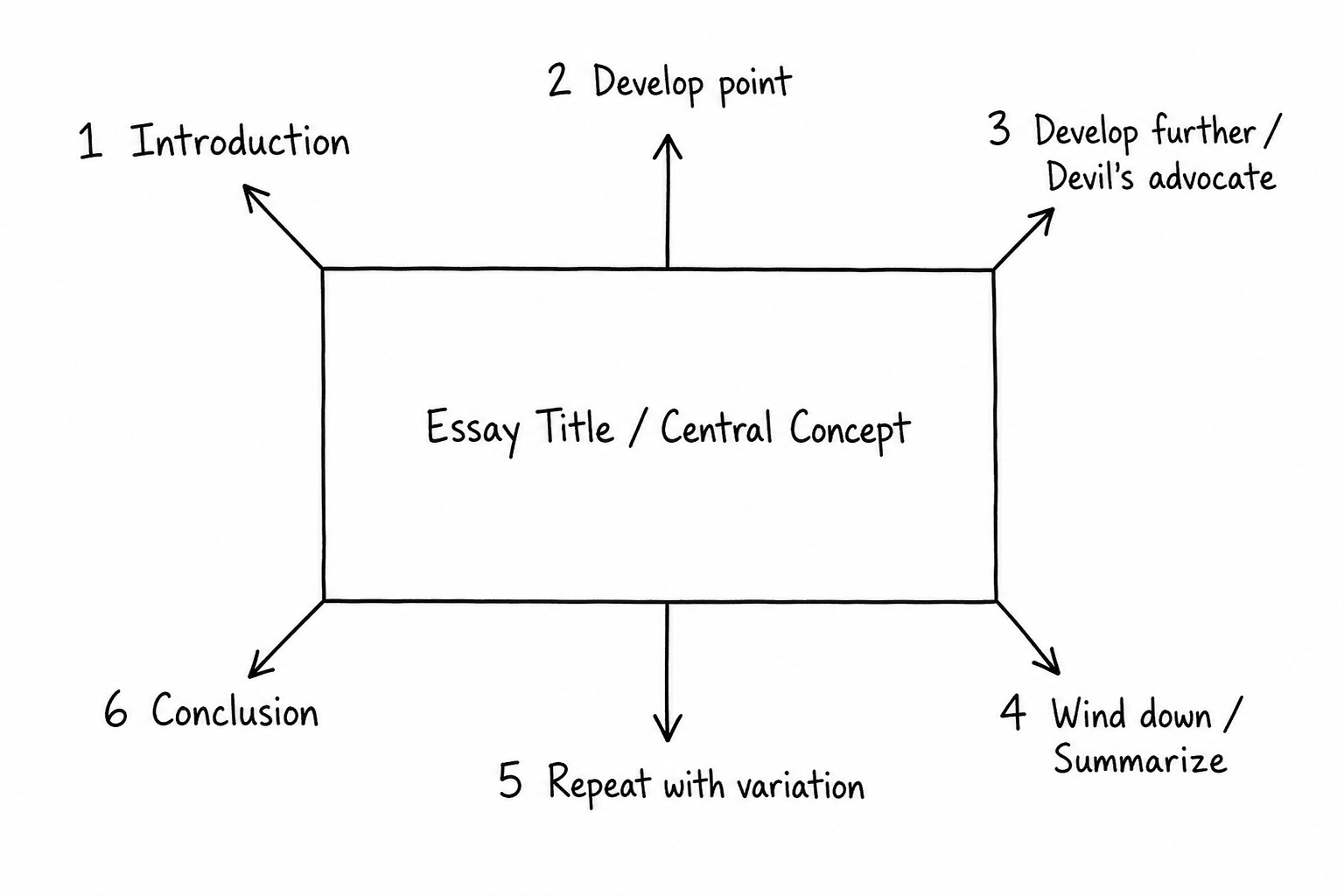
Then I read Zadie Smith’s “The Art of the Impersonal Essay,” in which she shared a “priceless piece of advice” that a teacher bestowed on her at age seventeen. It was a writing structure: a rectangle with six arrows that marked the journey that an essay should take, in stages. “I still use it,” Zadie Smith wrote: “Still think about it every time I sit down to write one of these things you are reading right now.”
Of all the essayists I admired, Smith seemed the most spontaneous, self-permissive, and digressive of the bunch. So I was mistrustful. I sat down to fact-check Smith’s claims using another of her essays, “Some Notes on Attunement,” collected in Feel Free, about getting on a level with Joni Mitchell’s music.
I’m drawn to this essay on account of its splendidly irregular references: the singer Elkie Brooks, the ruins of Tintern Abbey, Wordsworth’s Tintern Abbey poem, Allen Ginsberg, connoisseurship, Seneca, Kierkegaard’s “Fear and Trembling,” the story of Abraham and Isaac, and, of course, Joni Mitchell. This is the sort of associative movement I love.
Yet as I knew from my abortive scribblings, something more than a chain of associations was hooking me. There was another frame that held me suspended above these references, showing me how to regard them without bedding me in beside them.
Did the essay, perhaps, observe the six-arrowed rectangle?
Yes, it did.
Smith opens by establishing that her parents, “a young black woman and an old white man,” kept no white women in their record collection; when she first heard Joni Mitchell in college, she experienced “a piercing sound, a sort of wailing,” and disliked it. That dislike hardened, and years later, motoring to a wedding when Joni comes on the radio, she “started stabbing at the dashboard” to turn it off. During a pit stop at Tintern Abbey, though, she finds herself humming “a strange piece of music” and all at once, there’s a conversion. “I hated Joni Mitchell — and then I loved her.” From there Smith tells what kind of change this was by exploring what it wasn’t: not a slow, continuous accumulation of experience, but a leap, which she compares to Kierkegaard’s writing on faith. The conclusion returns to Joni and ties back to her opening: she’ll read any novel, has no walls for literature — and despite the walls she erects for music, maybe she’d have found Joni in the end regardless, because Joni, it turns out, was writing a novel.
My deconstruction of the essay is not the essay; it doesn’t come close to conveying what it’s like to read. But these are the major shifts that mark the arrows of the rectangle.
“Notes on Attunement” passed the test; “The North West London Blues,” also in Feel Free, did not. It’s a forceful piece about public spaces but I couldn’t grasp its thesis until the end — and even then, I had to read it several times to see how everything fit. The opening and closing arrows were there, but the middle was hard to parse. I think I’ve figured out why. Smith seems to be repeating the three-four-five move, in miniature, several times over. Microcosmic passages, where I’d expected one long progression.
Which leads me to conclude that Smith approaches the rectangle not with religious adherence, but has internalized its rhythms, and most importantly, its turns. The key is not to keep going in one direction but to turn corners. This keeps the drive interesting; this keeps the reader awake — the opposite of one long, lulling ride down the highway.
***
So Smith wasn’t pulling my leg: she really does use the rectangle; not perfectly, but its functions are there.
Solnit’s book does not fit the rectangle. If I try to classify her shape, I arrive at a mattress coil unfurled: an extension, and then a semi-return; a further extension, and again a semi-return. But that’s an overly rough account, because her returns — the callbacks to apricots, Frankenstein, Guevara — feel less rigid and more organic than a mattress coil suggests. At least initially. As the book draws to a close the surprise wears off, and the form begins to feel predictable.
Even still, I don’t want to overstate this minor criticism: the book is a success. Why does it work, despite its many digressions and recapitulations and circlings of the same ideas? Searching for clues, I peeked at the book’s table of contents, which I hadn’t yet seen since I was using an ereader that dropped me straight onto the first page.
Now, I caught an unmistakable shape, one that I had missed while remaining too close-in with the text:
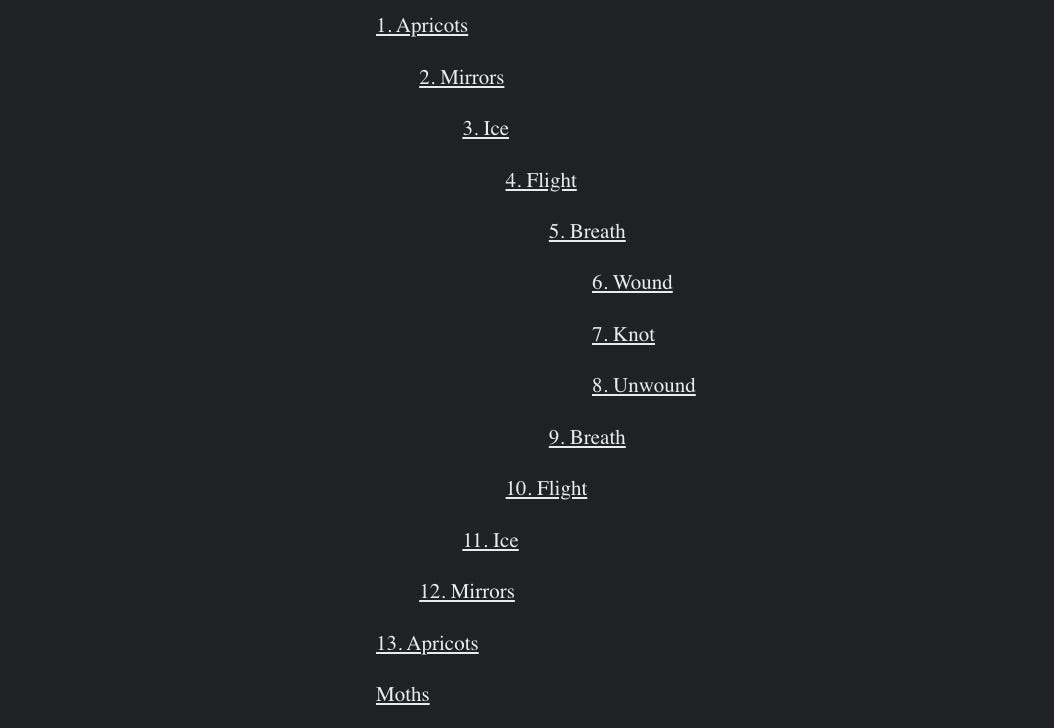
There it is: A voyage out, and then a palindromic return. (In the print version, “Moths” runs alongside the bottom of all chapters, threaded through the entire book.) The true shape of Solnit’s book isn’t found in its individual chapters, though as I had seen, they echo this shape in miniature. Each chapter is in service of a greater journey: one that takes you on the solitary boat to an unfamiliar shore, and brings you back the same way, where the already-seen landmarks now look different.1
Solnit reflects on the passage of time in her book, and specifically how we mark it differently based on where we live: away from the poles, the sun’s rise and set — separating the intervals of daylight and nightdark — bound our perception. But near the poles, like in the northern reaches of Iceland where Solnit stays, the year progresses as if in a single day: the long stretch of summer, when there is sunlight around the clock, and the vast stretch of winter, with its never-ending dark.
I think Solnit wound that structure into the book itself. Her vessel is one self-contained stretch of time: a rise, and a set. There is an order and logic that places the book inside a single day, no matter how much time passes as you read it.
***
Meandering within a container, then. That’s the secret. My early notion of formulas wasn’t so naive after all, but I was going about it the wrong way: I was patterning my content on other writers, rather than learning from their structure. In the nonfiction I admire, what appears to be random, or heedless, or self-indulgent isn’t, not completely. The container is the protection — a felt reassurance to the reader that you are holding them fast, not leaving them dangling. A reassurance for the writer, too: that you have latitude to meander because the container will keep you from going too far, that within the discipline of geometry you have freedom to range. The trail may be covered at times but it’s there if you look for it; a compact that ensures neither writer nor reader will get lost in the wilderness.
Now to find my container.
Last year, I wrote a piece on my shifting writing interests that feels like a prequel of sorts to this one — and I wrote it during our annual sojourn to Iceland, which we’re embarking on again in a week:

And a thread connects the “who is allowed to speak” reflection in today’s piece to this essay on Donna Haraway’s “god trick” theory, which transformed my thinking:

Stay curious,
Laura
After I wrote this piece, I went looking for a photo of the print version’s table of contents to see how it compared with my digital screenshot. I didn’t find one, but I did find this review of the book, and I was interested to see how reviewer B.R. Cohen described the book’s shape, echoing my estimation in some respects (the accordion metaphor), but making different discoveries, too:
The Faraway Nearby is also a palindrome. Or it’s a series of nested dolls, the structural metaphor Solnit uses a few times and the one the publisher trumpets from the cover. But it’s also a threaded fabric, a web, an accordion extending out and back. Maybe it unfolds to the middle and then refolds to the end. Only the process of reading the book brings out the two sides of that fold. Reading is unfolding. The storyteller needs the reader to form the other side.
Thank you so much for this. I've been struggling with how to structure nonfiction for ages. I rely on formulas a lot myself, and it seems like there are so many different ways to do nonfiction. I'm looking forward to reading your essay in Electric Lit, as well as some nonfiction by Zadie Smith and Elif Batuman.
Are you planning a NF one on Mrs Dalloway any time soon? I loved A Room of Her Own but still not read this