


A year and change into pitching my writing, I have no idea whether my numbers are good, mediocre, or abysmal. Being a lawyer by day and not having friends who do this sort of thing, I have little to compare against. For anyone who reads this who is also trying to publish their work, I hope this will encourage you to share your experiences, too, and we can build a little community together. Most of my readers will not be in that boat — it’s only a rare, unhinged few who pitch their work out with little hope of acceptance, let alone encouragement. Though hopefully this will still be of interest, as a window into an unknown world.
Or maybe you’ll be inspired to start writing, to become a man or woman “of letters,” as they used to call it. Published writing takes so many forms: reviews of all sorts (books, TV, film, video games, art); short stories; essays; satire; and if you’re more of a visual creator, cartoons and illustrations. My writing is like an intellectual “corner of one’s own.” A pursuit that is only for me; not a means to an end, like my workaday career which earns my living, but an end in itself.
Quick note: Strictly speaking, you can “pitch” an idea with no draft, or you can “submit” a draft that’s already written. I do both, though mostly the latter, but to avoid overcomplicating I’m just going to call it all “pitching.” Either way, you write a cover email/letter that explains your piece, and landing that cover message is most critical — assuming your draft delivers on what you’ve promised.
---
Last year, I read an interview by Naomi Kanakia of Irina Dumitrescu, described by Kanakia as “a literary critic and Medieval literature professor who regularly writes for The Times Literary Supplement, The London Review of Books, and The New York Times Book Review.” It was about how Dumitrescu, an academic, developed a “side gig” in popular criticism. One fact stuck with me: she consciously tried to “rack up rejections”:
Another thing I did, I was in a lot of writer’s groups on Facebook. And one of the ones I was in was dedicated to racking up a hundred rejections in a year. So I thought okay, I’m going to get over my fear of rejection. I pitched a bunch of places I would never have pitched before, and one of them was the NYT. They sent around my email amongst the staff, and six months later one of them came to me with something completely different to review. That’s how I got into the New York Times—it was really because I was trying to rack up rejections.
This seemed like a very good strategy. You give yourself permission to swing for the fences, and if you miss, well — that’s actually part of the plan.
Your strategy should also be informed by why you’re pitching. My goal is mostly this: I want to bring my ideas into wider conversations. I’d be lying if I didn’t say the gamesmanship of it is also appealing. This aspect scratches an itch like video games, where you unlock achievements. There are many “achievements” to unlock along the way of writing for publication, and their specific makeup will depend on what you value and what excites you.
I’m not aiming for “writer” to be my career. What this means, practically, is that I’m pitching pieces that are pulling me to be written. I’m not starting the opposite way, which is to choose topics according to what a publication might be looking for.
As a result, my pieces deal with far-flung topics. Right now, for instance, I have three fully written essays “in stock” that I’m pitching. They deal with: reinterpreting Jean Rhys’s life and work; revisiting A Room of One’s Own through the rediscovered Woolf work The Life of Violet; and a theoretical essay about negative reviews of literature. Not exactly hot takes.
---
A year in, here is my numerical snapshot:
59 pitches and submissions (and growing by the week)
3 acceptances
15 explicit rejections
The remainder is a blend of passive rejections (i.e., silence), withdrawing pieces that were accepted elsewhere, and pitches I’ve sent in the past month that may still be in contention
This amounts to a 5% acceptance rate. But that doesn’t convey much. If I pitched the New York Times all 59 times, I’m sure I’d be at 0% (and banned for spamming); if I was pitching my mom’s magazine, maybe the rate would be higher. (My mom doesn’t have a magazine.)
“All happy families are alike; each unhappy family is unhappy in its own way.” An acceptance is an undeniable signal: the editor liked your pitch or submission. A rejection is a many-faceted thing. Usually, the reasons remain opaque. The issue could be writing quality, lack of topic fit, an already full slate, lack of credentials, or even that the editors were too busy to read the pitch or submission.
I’m wary of reading signal from noise. Still. For some pitches, my cover email has been more distant and formal. In others, I let my subjectivity shine through — even at the risk of seeming amateurish or unstudied. The successful pitches have been my more relaxed, genuine missives. This could be pure coincidence. Or it could be the lesson I keep getting taught: presenting yourself as you are, and not the version you think someone wants, is the best path.
The only substantive rejection I’ve received was from The Drift, incidentally, on the pitch that was accepted by EL. They wrote: “It sounds like an interesting piece, but unfortunately it’s not quite a fit for us — in general, we look to publish pieces that make sharp, surprising, argumentative interventions in existing conversations.” I appreciated that they took the time to name what they thought was missing. And now I’m more targeted in pitching The Drift. For instance, I know my Jean Rhys piece isn’t a good fit; it’s not an existing conversation, not by a long shot.
---
I’ll share each successful pitch here in my newsletter after the piece is published.1
Today, it’s my Electric Literature pitch, and a bit on the process of acceptance and publication. In a companion piece, I’ll reprint the essay itself, thanks to EL’s writer-friendly terms (they require only 90 days’ publication exclusivity).
The idea for the essay began, like all my writing, with a personal question. I love nonfiction, but even still, I often abandon books. I get sated somewhere in the middle and move on to something else. Thus it was unusual when I read three separate nonfiction books straight through, my interest sustained until the end. I wondered: what was different about these? I looked at them as a group and saw shared qualities that were distinctive enough to form a micro-genre.
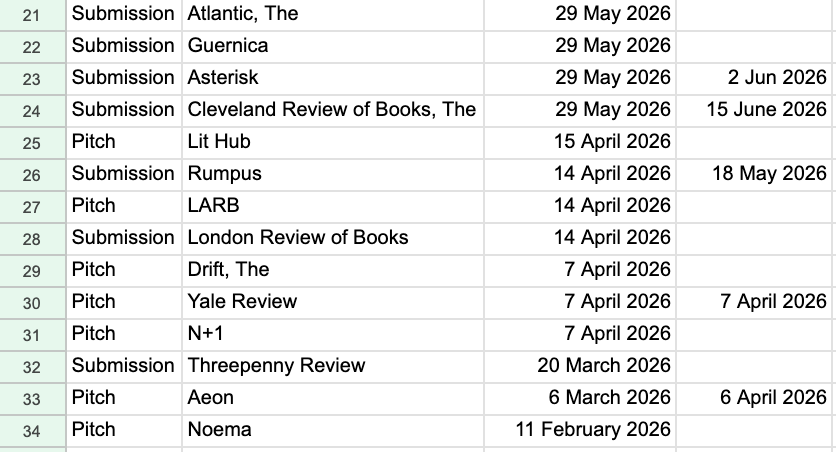
That’s the idea I pitched, tracing a new micro-genre. I targeted four places at once: Electric Literature, Los Angeles Review of Books, The Point, and The Drift. This is a strange assortment (they’re very different from each other), but I didn’t realize that at the time. Still, a batched approach has been my strategy ever since: unless a platform requires exclusivity, I pitch 3-5 places at once. And then I pause and see what happens. If a rejection comes in, that often spurs a new round. Otherwise, my prompt to get going again is simply remembering that it’s been a while since pitches went out. As you see, I’m pretty unsystematic, except for one thing: I maintain a spreadsheet where I track each pitch or submission by title, the publication, the date submitted, and the date of response.
---
Here’s the pitch to Electric Literature that won my first-ever response from an editor and first-ever publication:
Email Subject: Narrating Obsession: A Micro-Genre for Our Cultural Moment
Dear Editor:
I’d like to pitch a cultural criticism essay for Electric Literature’s website on a rising nonfiction micro-genre I call the obsessive quest book: nonfiction works in which a preternaturally curious narrator takes the reader on a first-person journey through an idiosyncratic obsession — one that ultimately opens out into broader cultural or philosophical meaning.
Recent examples include Rebecca Romney’s Jane Austen’s Bookshelf, Naomi Klein’s Doppelganger, and Lulu Miller’s Why Fish Don’t Exist. These works depart from traditional reported nonfiction by making the author’s personal investigative process the structural spine of the book. The narrator’s authority stems not from detachment, but from the intensity and transparency of their engagement.
I know this because these are the kinds of books I’m most drawn to. The three above are my best-loved nonfiction reads of the past few years. Reflecting on their commonalities led me to this micro-genre insight. [Note: A bit naive sounding — “best loved”! Not a lofty critical stance. But it worked.]
This isn’t an entirely new form — precursors include Joan Didion, John McPhee, and Susan Orlean — but today’s version is distinct. It treats subjectivity not only as an element of style or narrative device but as a methodological stance: reality is filtered through the self, and the self is the medium for discovery. These authors don’t just report on their topic; they reveal how their minds and personal lives become entangled in it. [Note: I try to situate whatever I’m arguing in a broader cultural/historical context, to show I’ve done my homework.]
I’ll argue that this micro-genre’s rise reflects a broader cultural moment — one defined by waning institutional authority, rising distrust of because-I-said-so expertise, and a turn toward self-curated knowledge. In other domains of pop culture, influencers offer behind-the-scenes access to cultivate an aura of authenticity, suggesting that this whole-person approach to creatorship is part of a wider trend. These books resonate because they make the messiness of sense-making visible and, in so doing, suggest that readers, too, can pull meaning from chaos.
The completed essay would be in the range of 2,000 - 2,500 words.
A lifelong reader and obsessive quester myself, I’m a tech lawyer and write under the pen name Laura Moore about history, cognition, and literature on my Substack, Strange Clarity.
Three weeks later, when I received a positive response, I thought: Wow, maybe I can actually do this. It felt like a kind of magic; what started as a whim could be given an official stamp somewhere. The editor said he had discussed the pitch with EL’s editorial team, and they were interested in a draft. I sent one a few weeks later, and it was accepted. Next came the editorial process, which unfolded over a few months. I revised the piece and worked with the editor on increasingly smaller rounds of edits through early November, right up until publication.
---
My first publication mostly involved various degrees of elation.
But there was a notable exception. EL, like most non-news platforms, doesn’t support comments. After the piece was live, I had no idea whether anyone connected with what I had written.
I even ran a URL search on the piece to see if it was discussed anywhere. (Is that pathetic? Well, it’s true.) It made a couple of link round-ups, but that’s it. No engagement with the substance. This was a bummer, I won’t lie.
But then, I took a risk and fortune smiled on me. After publishing my essay, I read Tiffany Watt Smith’s Bad Friend and saw that it fit the micro-genre in many respects. The author was on Substack. I took a chance and responded to one of her Notes with a link to my essay. This is considered quite poor Substack etiquette! Yet she generously read my piece and told me it was “brilliant,” saying: “well done for putting your finger on it so perfectly!” I was gobsmacked. That a “real” author whose work I so admired praised my essay meant the world. My resolve got a needed boost. It can be hard putting yourself out there as a nobody like me, and most of the time I veer between extremes, thinking either, Yes, I have something unique and worthwhile to say, or, I’m a near-clinical case of self-delusion and an embarrassment to myself. Trying to inaugurate a published writing program at age 40 when you have a full-time job, three kids, and a dog always in need of walking is either bold or pathetic, depending.
In a companion post coming tomorrow, I’ll reprint my Electric Literature essay, “Nonfiction Isn’t False, but Who Says It’s True?” along with some fresh observations on the genre.
All comments welcome. If you’re a writer who is pitching or has pitched, I’d love to hear your experiences here or via DM. Also, if you have resources that you’ve found useful, please link them in the comments!
Stay curious,
Laura
From the archives:


When a piece that was accepted for a spring 2026 publication didn’t appear in the issue, and the editors didn’t tell me in advance, I was pretty distraught. Now I’m wary of counting my chickens until the publication hatches. They’re saying it will appear in their autumn 2026 issue; I hope that’s the case.
Looking forward to your next piece. This was great 👍
Congratulations, Laura! This reminds me of what I used to love about publishing as an academic, as well as how I approached it. Wishing you continued rejections… and success! ☺️☺️